Purging vs breakout: how to tell them apart
Purging vs breakout, explained simply: what purging looks like, how long it lasts after retinol or acids, and the signs a new product doesn't suit you.
6 min read


Purging vs breakout is the question almost everyone asks a few weeks into a new retinol or acid. Your skin was supposed to get better, and instead there are new bumps. The good news is that the two usually look and behave differently. Once you know what to watch for, deciding whether to keep going or stop gets a lot easier.
This is general cosmetic advice, not medical advice. If anything hurts, spreads or keeps getting worse, stop the product and see a doctor.
What is skin purging?
Some products speed up how fast your skin renews its surface. Retinoids and exfoliating acids, such as glycolic, lactic and salicylic acid, are the usual ones. When that turnover speeds up, clogs that were already forming under the surface come up sooner than they would have. That is purging. It is not new trouble, just old trouble showing up early.
Here is the part most people miss: purging only makes sense with products that change how fast skin turns over. A new moisturizer, foundation or face oil does not purge. If one of those brings bumps, it is more likely a breakout, or a sign that the product does not suit your skin.
See how your skin settles
Skin Analysis and Progress in VIPAD follow your Blemishes reading week after week.
Purging vs breakout: what's the difference?
- Cause: purging follows an active that speeds up turnover. A breakout can follow anything, often a heavy or clogging product, or nothing new at all.
- Location: purging shows up where you usually get spots. A breakout from a product often appears in new places, where you rarely break out.
- Timing: purging usually starts within the first week or two of a new active. A breakout can start at any point.
- Speed: purge spots tend to come and go faster than your usual ones. Breakout spots keep their normal, slower pace.
- Direction: purging eases week by week. A breakout from a product that doesn't suit you keeps going, or gets worse, for as long as you use it.
What does purging look like?
Purging usually looks like small bumps, blackheads, whiteheads and a few red spots in your usual areas, often the chin, forehead and nose. Your skin may also feel a little dry or flaky, especially with retinol. Think of it as a busier version of your normal skin, not a different skin.
Some things don't fit purging at all: itching, burning, swelling, hives, a rash, or a patch of tiny bumps on an area that never breaks out. Those point to irritation or a reaction, not purging. Stop the product, and see a doctor if it is painful, spreading or doesn't settle within a few days.
How long does purging last?
There is no exact clock, but a common rule of thumb is about four to six weeks, which is roughly one round of skin renewal. Some people see it fade sooner. With stronger products it can take a little longer. More important than the date is the direction: week by week, it should be easing, not building.
If you are past six to eight weeks and your skin looks the same or worse, it is probably not purging. That product, or the way you are using it, may not be right for you.
How to get through purging more comfortably
- Start low and slow: use a retinol or acid two or three evenings a week, then build up.
- Keep the rest of your routine plain: a gentle cleanser, a simple moisturizer and sunscreen every morning.
- Don't stack actives. Skip scrubs, and don't use a retinol and an exfoliating acid on the same night.
- Leave the spots alone. Picking leaves marks that last longer than the spot itself.
- Moisturize when your skin feels tight or flaky. Dry skin feels more irritated.
- Change one thing at a time, so you know which product is behind any change.
Signs it's a breakout and you should stop
- The spots are in places you never usually break out.
- The product is a moisturizer, makeup or oil, not an exfoliating active.
- Nothing has improved after six to eight weeks of steady use.
- Your skin stings, burns, itches or swells when you apply it.
- The spots are deep, sore or spreading.
Stopping is not failing. Plenty of good products are simply wrong for one person's skin. Give your skin a week or two of a plain routine, and if things still don't calm down, talk to a doctor.
Track it instead of guessing
The hardest part of purging vs breakout is memory. Three weeks in, it is tough to remember how your skin really looked on day one. In VIPAD, Skin Analysis reads eight things from one selfie, including blemishes. Each reading gets a score from 0 to 100 and one of four steps: Room to improve, Moderate, Good or Very good. Take one before you start the new product, then repeat it every week or two in the same light.
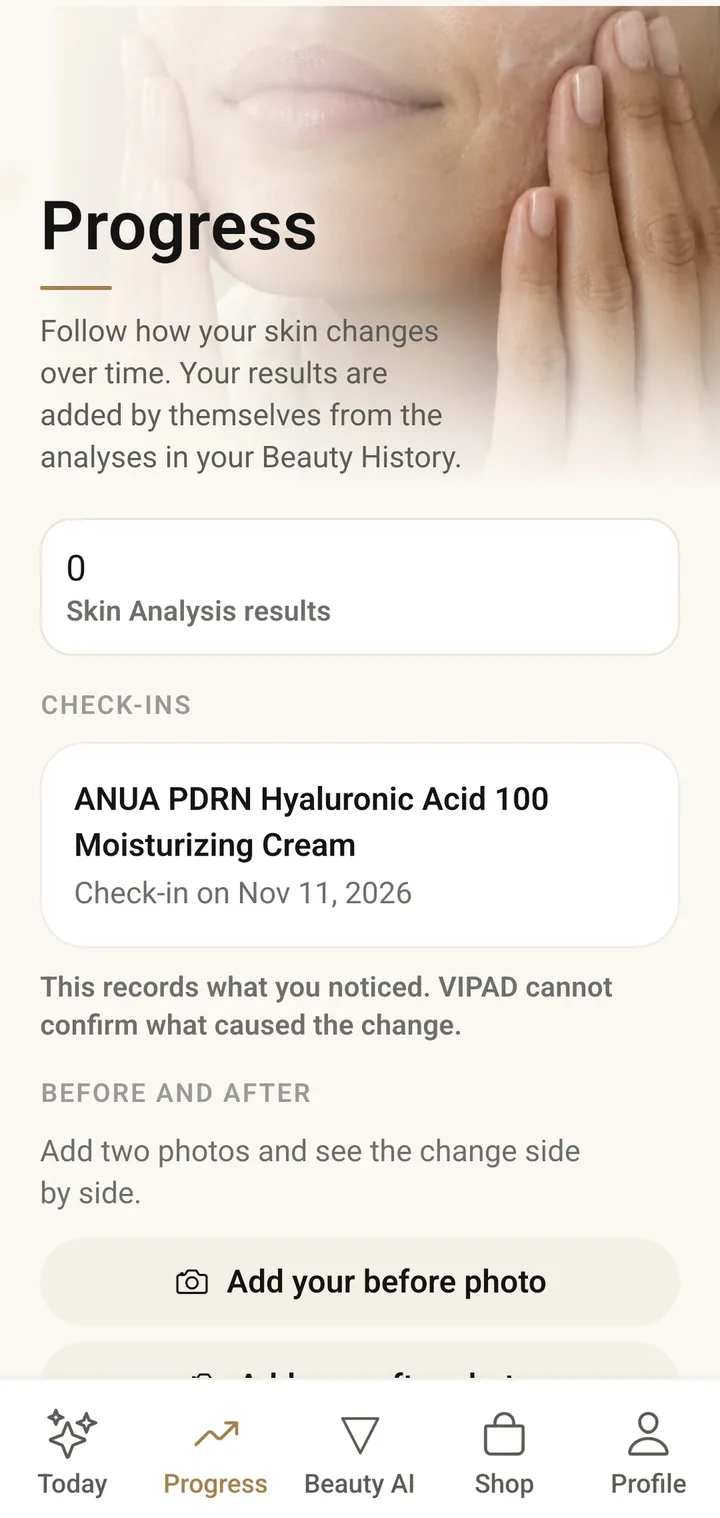
Progress compares your results over 1, 3, 6 and 12 months. If your Blemishes reading dips in the first weeks and then climbs back, that pattern fits an adjustment period. If it keeps sliding, that is your sign to rethink the product. VIPAD doesn't diagnose anything or tell you what caused a change. It gives you a fair record, so the decision is yours and it is based on more than a feeling.
Week by week
Progress puts your Skin Analysis results side by side, so you can see if things are settling.
Add the product to My Products with the date you opened it, and later mark whether it worked for you. Beauty AI, the chat in VIPAD that knows your results, products and routines, can help you plan how often to use a new active while your skin gets used to it.
Can a moisturizer cause purging?
Not really. A moisturizer without exfoliating actives doesn't speed up skin turnover, so new spots after one are more likely a breakout. Check the label: if it contains a retinoid or an acid, purging is possible.
Should I stop retinol if I'm purging?
Usually you can keep going at a lower frequency, for example every third night, as long as your skin isn't burning or swelling. If it is, stop. If it is just dry and a bit bumpy, slow down rather than quit.
Does everyone purge?
No. Many people start a retinol or acid with no purge at all, especially with a gentle formula and a slow start. So don't expect it, and don't keep a product just because you assume it is purging.
See how your skin settles
Skin Analysis and Progress in VIPAD follow your Blemishes reading week after week.