Is my skincare product working? How to judge it fairly
How long to give a new skincare product, how to test one change at a time, what to write down and how to compare photos fairly before you buy it again.
5 min read



You started a new serum three weeks ago. Your skin looks a little better, or maybe the same, or maybe it is just a good week. Most people stop or keep a product based on a feeling. A fair test takes a little planning, but it saves money and stops you from giving up on something that was about to show its value.
How long to give a new product
Different products answer different questions, and some answer faster than others. Skin renews its surface gradually, over weeks rather than days, so most treatments need patience. As a rough guide:
- Cleansers and moisturizers: a week or two tells you whether they feel comfortable and suit your skin.
- Hydrating serums: how your skin feels often changes within days, and how it looks within a few weeks.
- Exfoliants and products for texture or radiance: give them about four to eight weeks of regular use.
- Retinoids: often take a few months, and the first weeks can bring some dryness while your skin adjusts.
- Sunscreen: judge it on comfort, finish and whether you are happy to wear it every day.
Many brands print their own timeframe on the pack, which is a good guide too. One rule overrides every timeline: if a product burns, itches, causes swelling or makes your skin feel worse each day, stop using it. No waiting period applies to a reaction.
Follow a product for 30 days
My Products, check ins and Progress in VIPAD help you see what really worked.
Plan the test before you open the jar
The single most useful rule is to change one thing at a time. If you start a new serum, a new moisturizer and a new cleanser in the same week, you will never know which one made the difference, good or bad.
- Keep the rest of your routine exactly as it is for the length of the test.
- Patch test first on a small area, such as the side of the neck or behind the ear, for a few days.
- Start slowly with strong actives, for example every other evening, before using them daily.
- Use the amount and the frequency the pack suggests, not more.
- Write down the date you started. It is the easiest detail to forget.
What to write down
A few lines a week is enough. You are not keeping a diary, only noticing patterns you would otherwise forget.
- How your skin feels in the morning: tight, comfortable or oily.
- Any stinging, redness or new breakouts, and where they appear.
- How often you actually used the product that week.
- Things outside the routine that also affect skin: poor sleep, stress, travel, a change in the weather, your cycle.
- One honest sentence: would you buy this again today?
The outside factors matter. A product that seems to fail during a stressful, sleepless month may be doing its job well. A product that seems to work during a holiday by the sea may simply be enjoying the humidity.
How to compare photos fairly
Photos are the most convincing record and the easiest to get wrong. A change in light can make skin look smoother, redder or more even than it is. To compare fairly, the photos have to be taken the same way each time.
- Take a starting photo before the first use, not a week later.
- Use the same spot, facing the same window, at a similar time of day.
- Photograph bare skin a few minutes after cleansing, not straight out of a hot shower.
- Hold the phone at eye level and at the same distance, with your hair away from your face.
- Turn off filters, beauty modes and editing, and keep the photos as they came out of the camera.

Fair photos
Same window, same angle, no filters. Repeating the setup is what makes two photos worth comparing.
Judge the result honestly
At the end of the test, you will usually land on one of four answers: it improved, it stayed about the same, it got worse, or you are not sure. All four are useful. Not sure is a real answer, and often a sign to continue a little longer or to compare more carefully.
About the same, after a fair test, is information too. A product that changes nothing you can see may still be pleasant to use, but it is probably not the one to restock at a higher price.
Keep in mind that noticing a change does not prove what caused it. Seasons, hormones, sleep and other products all play a part. The aim is not to reach a scientific verdict, only to make a calmer, better informed decision about whether to buy the product again.
How VIPAD helps you finish the test
In VIPAD, every product you add to My Products can be followed with Track a result. You choose a check in after 14, 30 or 60 days, and you can add a before photo if you like. VIPAD then asks how it went on the date you chose. If you are not ready yet, you can postpone the check in or skip it.
The check in follows the same logic as this guide. You pick one of the four answers above, say whether you would keep using the product and how satisfied you are, and add a note or an after photo if you want. VIPAD keeps what you noticed and says plainly that it cannot confirm what caused the change.
On the product itself, you can also mark whether it worked for you, did not work or you are not sure, and give it your own rating. When you mark a product as finished, VIPAD suggests recording how it went, so the answer is there the next time you stand in front of the same shelf in a store.
Progress puts it all on one page
Progress collects your check ins, your active goals, the before and after photos you added and your Skin Analysis results. If you repeat Skin Analysis the same way during a test, Progress compares the results over time, across months up to a year. The photos you add there are kept private, exactly as you took them.
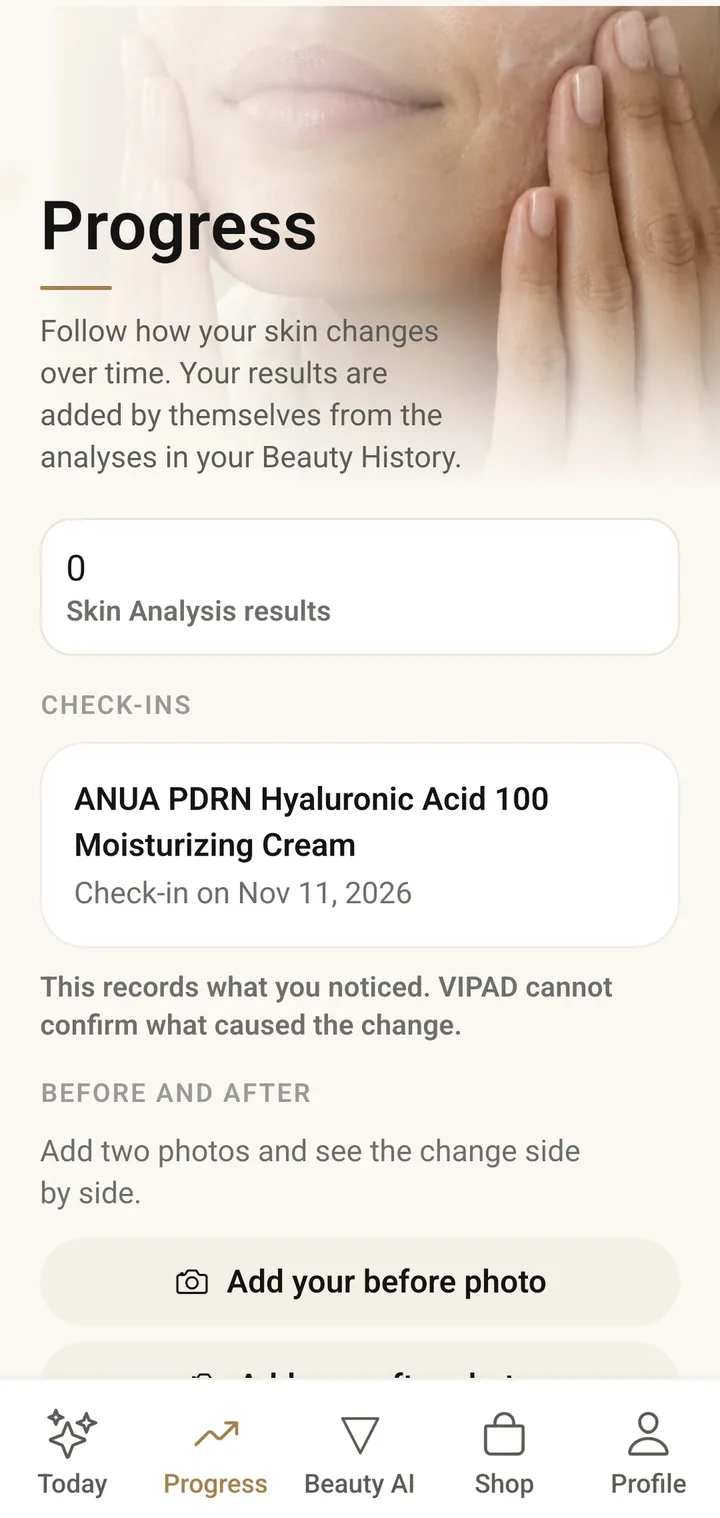
In the app
Progress shows measured results, check ins and your own before and after photos together.
Progress is careful with what it claims. A comparison needs at least two results of the same analysis, and two results show a change, not yet a trend. That honesty is exactly what a fair product test needs.
Your check ins also shape what VIPAD suggests next. The products marked For you in the VIPAD Store are based on your Beauty Profile, My Products and your own reports. If you reported that a product did not work for you, the Store tells you so when you look at it again.
Follow a product for 30 days
My Products, check ins and Progress in VIPAD help you see what really worked.