AI skincare routine generator: what makes a good one
A good AI skincare routine generator reads your skin, uses what you own and explains every step. Here is what to look for before you trust one.
5 min read


An AI skincare routine generator promises a routine in seconds: you answer a few questions and get a morning and evening list back. Some of those lists are useful. Many are the same routine anyone with your skin type would get, with a few product types moved around.
The difference comes down to one question: what does the AI actually know about you? This guide covers what a good tool should do, where a regular chatbot falls short, and how VIPAD builds a routine around your own skin and your own shelf.
What does an AI skincare routine generator do?
At its simplest, it takes information about your skin and turns it into steps in the right order: cleanse, treat, moisturize, protect. Most tools ask about your skin type, a concern or two and maybe your budget. Then they suggest a product type, or a product, for each step.
That is a fine start. The catch is that a routine is only as good as the information behind it. If the tool only knows what you typed, it is working from your best guess about your own skin.
A routine built around you
Skin Analysis, Beauty AI, My Products and Skin Care Plan work together in VIPAD.
A chatbot routine vs. a routine built around you
You can ask any general chatbot for a skincare routine and get a reasonable answer. It builds that routine from what you type. If you write "combination skin, a little redness," it builds for that description, whether or not it matches what is actually on your face.
It also has no idea what is in your bathroom. So it suggests a cleanser, a serum and a moisturizer as if you were starting from zero, when you might already own three of the right things.
An AI that has read your skin from a photo and knows the products you already own can work differently. It can see that your moisture reads lower than your oiliness, notice you already have a gentle cleanser, and build the routine around those facts instead of a guess. That is the honest gap between the two. It is not about how smart the AI is. It is about how much true information it has.
What makes a good AI skincare routine builder
If you are comparing tools, these five things matter more than how polished the answer sounds.
- It reads your skin. A reading from a photo gives the routine a real starting point, instead of a self description that may be off.
- It uses your products. A good AI skincare routine builder starts from your shelf and only suggests something new when there is a real gap.
- It asks before it guesses. If it does not know your sensitivities or your budget, it should ask, not fill the blank with an assumption.
- It explains why. Each step should come with a short reason, so you understand what you are doing and can adjust it later.
- It tracks results. A routine is a test. Without a way to see what changed after a few weeks, you never learn what worked.
AI skincare routine analysis: why the photo comes first
When people look for AI skincare routine analysis, they usually want two things: a read on their skin and a routine that answers it. The order matters. Reading first means the routine responds to something measured, not to how your skin looked in the mirror one tired morning.
In VIPAD, Skin Analysis reads 8 things from one selfie: moisture, redness, smoothness, pores, blemishes, oiliness, dark circles and glow. Each one gets a score from 0 to 100 and one of four steps: Room to improve, Moderate, Good or Very good. If you want more, the optional Signs of aging add on adds fine lines, dark spots, firmness and under eye puffiness.
That gives a routine something concrete to aim at. Low moisture with good oiliness points to a different evening than the other way around. Keep in mind that these readings are cosmetic. VIPAD does not diagnose or detect any skin condition, and it is not a medical device.
How VIPAD builds your routine
VIPAD is not one routine button. It is a few connected parts, and each one holds a piece of what a good routine needs.
- Skin Analysis: the 8 readings from one selfie described above.
- My Products: what you own, when you opened it, when it expires and whether it worked for you.
- Beauty AI: a chat that works like a personal esthetician. It knows your Beauty Profile, your Skin Analysis results, your Personal Color, hair and face results, your products and your routines, and it asks first when something is missing.
- Skin Care Plan: a plan built from your latest Skin Analysis.
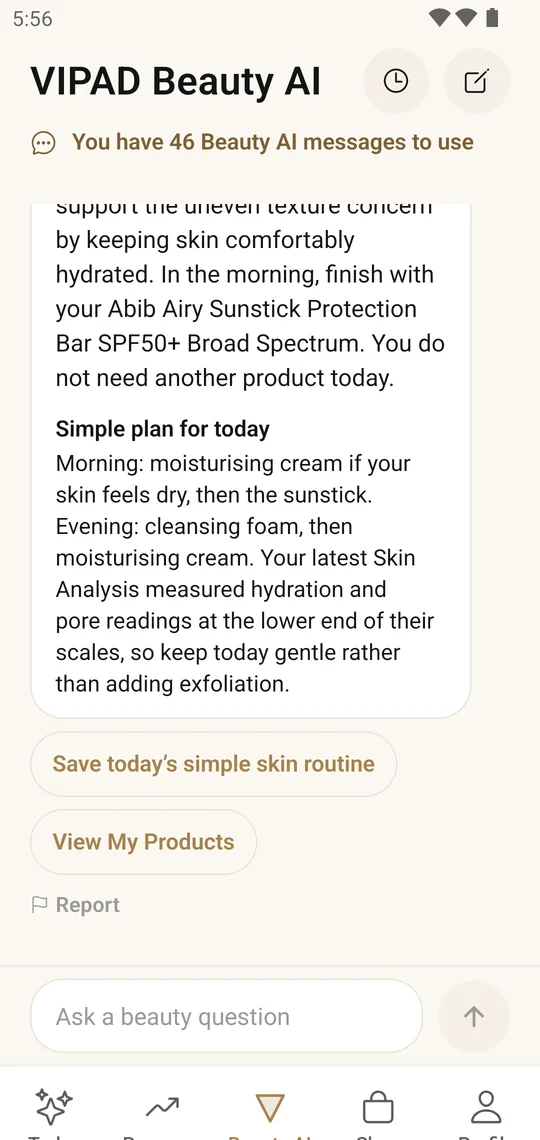
Ask Beauty AI for a simple evening routine and it drafts one from the products in My Products, in a sensible order, with a reason for each step. If there is a real gap, VIPAD Store can suggest a product that fits you, with Amazon links in the US and some European countries. You decide what to save and what to follow.
In the app
Beauty AI builds a plan for today from a Skin Analysis result and the products already in My Products.
Then Progress closes the loop. Take a new Skin Analysis later and compare your results over 1, 3, 6 and 12 months, so you can see whether the routine moved anything instead of guessing.
Is there a free AI skincare routine tool?
Plenty of tools let you type in your skin type and get an AI skincare routine for free. For a first idea, that is fine. Just remember what it is working from: your own description and nothing else.
VIPAD has no subscription. It works with Credits instead, so you spend them on what you actually use, like a Skin Analysis, and you are not paying every month for an app you open twice.
How long before you know a routine works?
Give a new routine a few weeks before you judge it, and change one thing at a time. If you swap three products at once and your skin looks better, you will not know which one did it. A fresh reading after a month or more tells you more than one good or bad day.
When should you skip the AI and see a doctor?
An AI routine is for everyday cosmetic care. If your skin hurts, burns, swells, spreads or keeps getting worse, that is a question for a doctor, not for a routine tool. Beauty AI can help you write down what to ask, but it does not diagnose or treat anything.
The best AI skincare routine generator is the one that knows the most true things about you: what your skin looks like, what you already own and what changed since last time. Start there, keep the routine short, and let your results tell you what to keep.
A routine built around you
Skin Analysis, Beauty AI, My Products and Skin Care Plan work together in VIPAD.