What is an esthetician, and when should you see one?
What an esthetician does, how they differ from a dermatologist, how to prepare for your visit, and where a beauty app can help you between appointments.
6 min read



An esthetician is a skin care professional who focuses on how your skin looks and feels. They cleanse, exfoliate, hydrate and care for the surface of the skin, and they help you understand what it needs from day to day. Many people book a facial without knowing what the person in the treatment room was trained to do. Knowing that makes every visit more useful.
What an esthetician does
In many countries and states, estheticians need training and a license to perform cosmetic treatments on the skin. The exact list depends on local rules and on where they work, but a typical menu looks like this.
- Facials: cleansing, exfoliation, masks and massage, adjusted to how your skin looks on the day.
- Extractions: careful removal of blackheads and clogged pores with clean tools and the right technique.
- Exfoliating treatments: enzyme treatments, light peels and other surface treatments that local rules allow.
- Hair removal: waxing, threading or sugaring for the face and body.
- Brows and lashes: shaping, tinting and lifts.
- Skin coaching: a look at your routine, with advice on what to keep, what to change and how to apply it.
Some estheticians work in day spas and salons, others in clinics next to doctors. Those in a medical setting may help with more intensive procedures under a doctor's supervision. The rules differ a lot between countries and states, so it is always fine to ask what a treatment involves and who performs it.
Your esthetician for everyday questions
Beauty AI, salon search and appointment reminders are all in VIPAD.
Esthetician or dermatologist?
The simplest way to tell them apart is this. An esthetician cares for the appearance of healthy skin. A dermatologist is a doctor who diagnoses and treats skin conditions. An esthetician does not prescribe medicine or diagnose disease, and a good one will tell you when something belongs in a doctor's office.
Book a doctor or a dermatologist rather than a facial when you notice any of the following.
- A mole or spot that changes in size, shape or color, bleeds or does not heal.
- Breakouts that are painful or deep, leave marks, or do not respond to gentle care.
- A rash, swelling, strong itching or burning, especially if it spreads.
- Redness or flaking that lasts for weeks without a clear reason.
- A reaction to a product that affects your eyes, your breathing or your sleep.
For everyday concerns such as dull skin, rough texture, shine, visible pores, dryness in winter or simply wanting your skin to feel cared for, an esthetician is a good place to start.
When a visit is worth it
You do not need a facial every week to have good skin. A visit is most useful at turning points. Before an important event, book a week or two ahead rather than the day before, so any redness has time to settle.
Other good moments are when the season changes and your skin starts to behave differently, when you have bought several new products and feel lost, or when you want hands on help, such as extractions or brow shaping, that is hard to do well at home.
How to prepare for your appointment
Your esthetician sees your skin for about an hour. The more you bring with you, the better their advice can be.
- Bring a list of what you use: the brand and name of your cleanser, serums, moisturizer, sunscreen and anything with acids or retinoids.
- Note what your skin did recently: a reaction, a product that stung, a breakout that keeps coming back in the same place.
- Ask whether to pause anything: many salons ask you to stop strong exfoliants or retinoids for a few days before waxing or peels. Ask when you book.
- Mention sunburn, recent treatments and any medicine you were told can make skin more sensitive.
- Arrive with little or no makeup if you can, so your skin can be seen as it is.
- Say what you want in plain words, such as brighter, smoother, less shine or calmer. One clear goal is easier to work on than five.
After the visit
Ask for the aftercare steps and write them down: what to skip for a day or two, how to protect your skin from the sun and when to come back. Skin can look pink for a few hours after a facial. Redness that grows, burns or hurts is a reason to call the salon or a doctor.
A good esthetician also tells you what to do at home. Ask which one or two products from your list they would keep, which they would pause, and what you should expect over the next few weeks. Those answers are often worth as much as the treatment itself.
What an app can do between visits
Most skin questions come up at home, not in the treatment room. Can I use this serum with my retinol? Why does my skin feel tight in the evening? Is this new cream worth keeping? This is where Beauty AI in VIPAD helps. It works as your personal esthetician for everyday questions and answers from your Beauty Profile, your analysis results, the products you own and your routines.
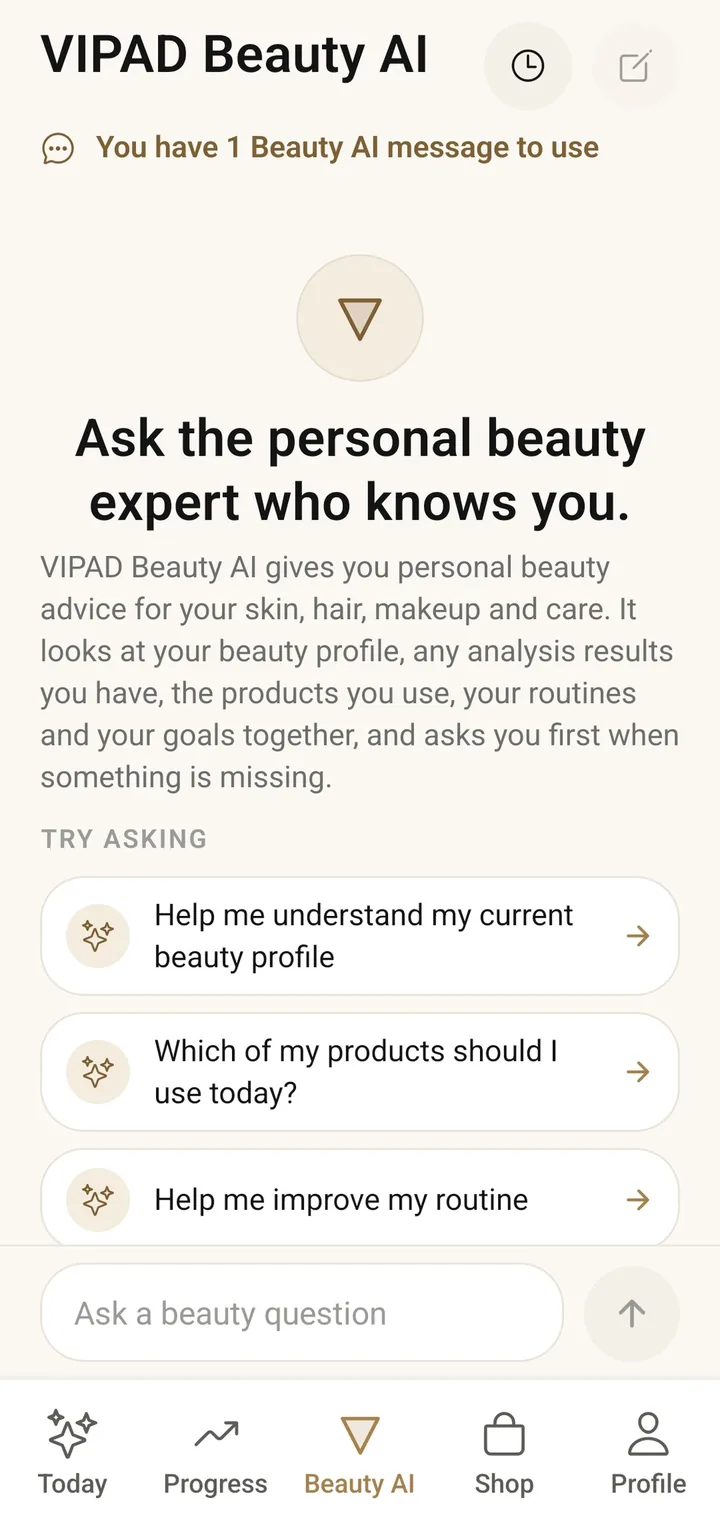
Everyday questions
Beauty AI starts with suggested questions, or with anything you want to ask about your own skin and products.
Because it knows your shelf through My Products, Beauty AI can tell you which of your products already fit a goal before it suggests anything new, and it can draft a routine from what you own. If it lacks a detail it needs, it asks you rather than guessing. Messages come with VIPAD Credits, one message for each Credit, and there is no subscription.
VIPAD also helps around the appointment itself. You can find beauty salons by city or near you, save the ones you like and add your appointment with a reminder. After the visit, you can record it in your Beauty History, so your next booking starts from what was done last time.
If you use Skin Analysis, its seven readings are saved privately in your Beauty History too. That gives you a steady record of how your skin looked between visits, which can be a useful starting point for a conversation with your esthetician.

Between visits
A photo taken in soft, even light gives you something steady to look back on before your next appointment.
What an app cannot do
An app is not a person in the room. It cannot touch your skin, feel how it reacts, perform an extraction or adjust a treatment as it goes. Beauty AI gives cosmetic guidance. It does not diagnose or treat any medical condition, and for a health concern it points you to a qualified professional.
- Use Beauty AI for everyday routine questions, how your products work together, what to try first and what to ask at your next appointment.
- Use an esthetician for hands on treatments, extractions, waxing, brows and a trained eye on your skin.
- Use a doctor or dermatologist for anything painful, changing, spreading or worrying.
The best results usually come from both: a professional who sees your skin a few times a year, and a clear, simple plan you follow every day in between.
Your esthetician for everyday questions
Beauty AI, salon search and appointment reminders are all in VIPAD.